
Services
A CRM your team trusts starts with the data model.
Property governance, deduplication, schema design and source-of-truth rules, built so clean data stays clean.
Data + CRM Architecture
One-time cleanups grow back. We fix why the mess happens.
Most teams ask for a data cleanup. They get one, and six months later the duplicates are back. The cause is almost always structural: several people with admin rights, imports nobody validated, integrations writing to the same fields, and no rules for creating new properties.
Every team, agency or contractor that works in a portal tends to leave fields behind. Nobody deletes the old ones because nobody is sure what depends on them. A few transitions later, the same concept exists in a dozen variants and two dashboards disagree.
Signs you need this
What bad data looks like from the inside
Reports that disagree
Nobody knows the real field
Imports that add duplicates
These usually trace back to the same few structural problems.
How we approach it
Evaluate, enforce, then clean up
We find out why the data keeps breaking before we clean anything up.
Evaluate
What exists, and what's missing?
Enforce
What keeps it clean?
Clean up
What's left to fix?
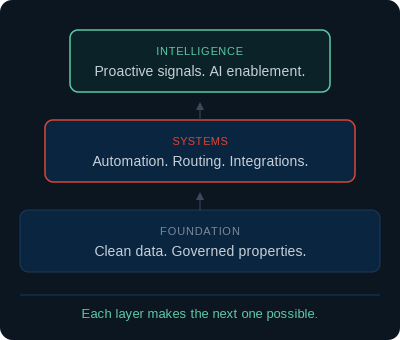
Why it matters for AI
Agents are only as good as the data they read.
HubSpot agents read your CRM and act on it. If the data underneath is inconsistent, they give confident, wrong answers, and your team learns to ignore them.
That's why the data model comes before any agent.
What's included
What we build and leave in place
A source of truth for every field
Deduplication rules, merge policies, and one designated source for each field that matters.
Property governance
Naming conventions, data type validation, and approval before new properties get created.
Ongoing data quality
Monitoring, exception reporting, and validation on every import so problems surface early.
How we think about this
Data integrity in HubSpot
If you exported your contact database today, how many records would be complete and accurate? Why the answer is usually lower than teams expect.
How to Work With Us
Two ways to engage. Same capabilities. Same team.
Both models give you access to the full range of services above. The difference is how we scope, schedule, and price the work.
Managed Services
Your ongoing operations partner. A dedicated team, proactive audits, and regular strategy calls. Scope evolves with the business.
Best for: Teams that need the role, not just the project.
See plansPre-Paid Hours
On-demand access to the Fission team. Purchase a block of hours, submit work as needed, and get results with transparent pricing.
Best for: Teams with project-based needs or defined scope.
See pricingFAQ
Common questions about HubSpot data and architecture
Because something keeps creating them. Usually it's an import without validation, an integration matching on the wrong field, or a form that creates new records instead of updating existing ones. We find the source and fix it there, then clean up what's already in the portal.
We archive instead of deleting wherever HubSpot allows it, and we review anything we remove with you first. Properties with no writer and no reader are the main candidates, and archiving keeps them recoverable.
It depends on the size of the portal and how many systems write to it. We scope it after our first look inside your portal. The rules that stop the mess from coming back go in before the bulk cleanup, so the work holds.
Yes. AI acts on your CRM data, so unreliable data just produces unreliable output faster. Fix the data model first and agents become worth turning on.