
Services
A process only works if people follow it.
We design how work moves within and between your teams, build it into HubSpot, and help your people adopt it.
Process + Change Management
Most adoption problems are process problems.
When a team stops using what was built, leadership usually treats it as a discipline problem and schedules more training. That rarely fixes it, because the real cause is usually the process itself. Sometimes it was never defined well enough to follow. More often, the person entering the data gets nothing back for the effort.
So people work around it. Deals get tracked in a spreadsheet, and HubSpot gets the bare minimum. On paper the system is implemented. In practice, the work happens outside it.
Signs you need this
Where it shows up
Work happening outside HubSpot
Changes nobody hears about
Handoffs that depend on one person
Another training session won't fix any of these.
How we approach it
Evaluate, design, then roll out
We design the process with the people who run it, then help them make the switch.
Evaluate
How does the work really get done?
Design
What should the process be?
Roll out
How do people make the switch?
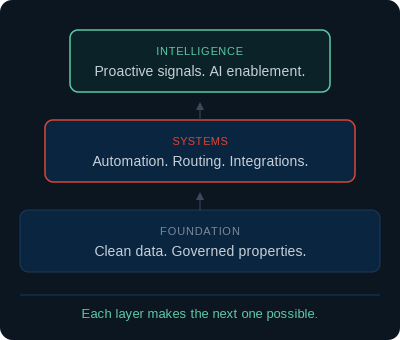
Why it matters for AI
Agents follow the process you've written down.
HubSpot agents can only follow steps that exist and are written down. A process that lives in someone's head can't be handed to an agent, or to a new hire.
What's included
What we build and leave in place
Process maps and definitions
How work moves within and between teams, including deal stages and lifecycle definitions with clear entry and exit criteria.
SOPs and the Master SOP
Step-by-step guides for each process, plus one reference for how your HubSpot is built and why.
Training and adoption tracking
Role-based training at rollout and adoption measured over time, so drift gets caught early.
How we think about this
Pipeline design in HubSpot
Deal stages are one of the most common places process work starts. What it takes to build a pipeline your team can forecast from.
How to Work With Us
Two ways to engage. Same capabilities. Same team.
Both models give you access to the full range of services above. The difference is how we scope, schedule, and price the work.
Managed Services
Your ongoing operations partner. A dedicated team, proactive audits, and regular strategy calls. Scope evolves with the business.
Best for: Teams that need the role, not just the project.
See plansPre-Paid Hours
On-demand access to the Fission team. Purchase a block of hours, submit work as needed, and get results with transparent pricing.
Best for: Teams with project-based needs or defined scope.
See pricingFAQ
Common questions about process and change management
Usually because the process behind it doesn't work for them. Most often, the person entering the data gets nothing back for doing it. We fix the process first, then train on it.
We involve the people who run the process in designing it, roll changes out with SOPs and training for each role, and check adoption after launch. When something changes later, the team hears about it before it affects their work.
One per distinct sales motion. New business, expansion and renewal usually behave differently enough to need their own stages. Separate pipelines for every product or rep usually make reporting harder.
They're the conditions a deal has to meet to enter or leave a stage, such as a confirmed budget owner or a completed demo. They turn stage movement from a judgment call into something you can check, which is what makes a forecast reliable.
Yes. We find the records whose stage contradicts what happened, like customers with no closed deal, then agree definitions with your team, automate the transitions and correct the existing records.