
Services
One GTM system, from target account to renewal.
A defined ICP, tiered and enriched accounts, priorities for every rep, and handoffs that hold from first touch through renewal.
GTM + Revenue Operations
Most revenue leaks start before the first handoff.
Some teams have a GTM motion with gaps between marketing, sales and client success. Others are building one from scratch: no written ICP, no account tiers, and reps deciding each morning who to call.
Either way, the fix starts in the same place. Agree on who you sell to, put that definition in HubSpot, and run every handoff after it on the same data.
Signs you need this
Where a missing GTM foundation shows up
No written ICP
Every account looks the same
Reps build their own lists
Sales in the dark
Surprise handoffs
Quiet accounts nobody notices
Each one traces back to a definition nobody wrote down or a handoff nobody owns.
How we approach it
Define, build, then prioritize
We agree on who you sell to before we build anything that depends on it.
Define
Who do you sell to, and who owns each stage?
Build
What does a rep see when they open an account?
Prioritize
What should each rep work this week?
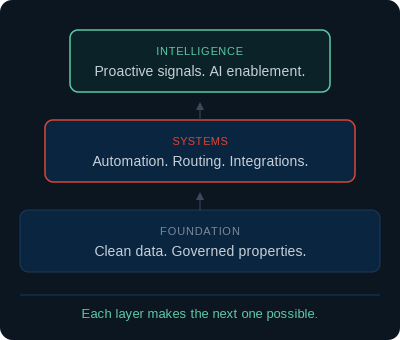
Why it matters for AI
Prioritization agents are only as good as your ICP.
An agent can research a company, tier it and tell a rep which accounts to work on Monday. It does that from the ICP definition and the properties in HubSpot. If the ICP lives in a slide deck and half your accounts have no industry or revenue, the agent ranks the wrong accounts with total confidence.
The same holds later in the lifecycle. When marketing, sales and client success each keep part of the story somewhere else, account agents only see part of it.
What Gets built
A great GTM system includes...
ICP and account tiers
Your ICP written down and calculated as a tier on every company record in HubSpot.
Account enrichment
New companies researched and filled in automatically, with a short review queue for the ones that need a person.
SDR and AE prioritization
A ranked list of accounts for each rep, with a reason for each, delivered where they already work.
Shared lifecycle definitions
One definition of each stage, agreed across marketing, sales and client success.
Handoffs with SLAs
Clear owners and response times at every transition, enforced in HubSpot.
Customer health signals
Health scoring, renewal automation and risk flags that someone actually watches.
How we think about this
Cross-functional operations
If a client went quiet across every channel this week, would anyone notice before the renewal? How we think about connecting marketing, sales and CS.
How to Work With Us
Two ways to engage. Same capabilities. Same team.
Both models give you access to the full range of services above. The difference is how we scope, schedule, and price the work.
Managed Services
Your ongoing operations partner. A dedicated team, proactive audits, and regular strategy calls. Scope evolves with the business.
Best for: Teams that need the role, not just the project.
See plansPre-Paid Hours
On-demand access to the Fission team. Purchase a block of hours, submit work as needed, and get results with transparent pricing.
Best for: Teams with project-based needs or defined scope.
See pricingFAQ
Common questions about revenue operations
One operating model across marketing, sales and client success, built into one system. It starts with a shared definition of who you sell to and carries through lifecycle stages, handoffs with owners and SLAs, and reporting that follows a customer from first touch through renewal.
Right there. We start with your closed-won deals and the people who sell, agree on the few criteria that separate good accounts from bad ones, and turn them into a tier HubSpot calculates on every company. Enrichment and rep prioritization come after, because both depend on that definition.
Not always. We start with HubSpot's native enrichment and agents, and add a tool like Clay only for the data HubSpot can't find. Fewer tools means one system of record that your reps and your agents all read from.
Yes. Your marketing agency runs campaigns and content. We handle the operations underneath them: ICP and account tiers, routing, handoffs, lifecycle definitions and reporting.
Start by asking what the person logging the data gets out of it. If the only answer is that their manager gets a report, they'll stop logging. We cut the extra work and make the record useful to the person filling it in.